
-
Unbound for Suffrage125 the final coat in images
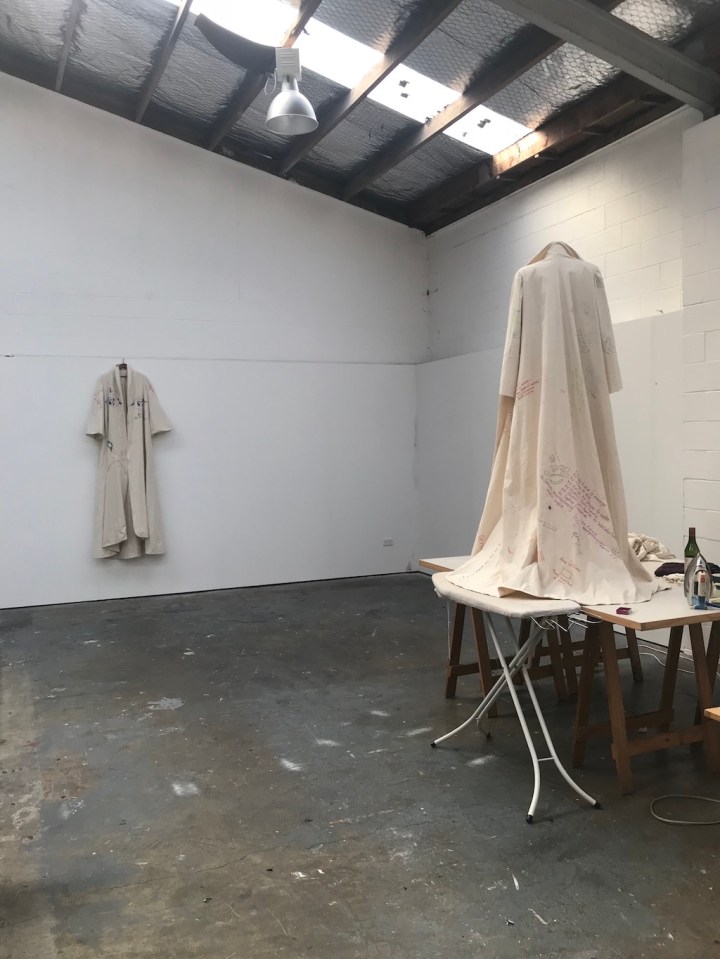
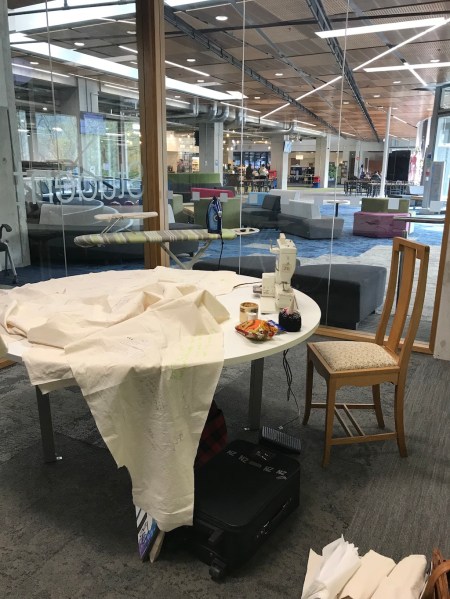
All set, a sweet little domestic Bernina, a beautiful sewing chair
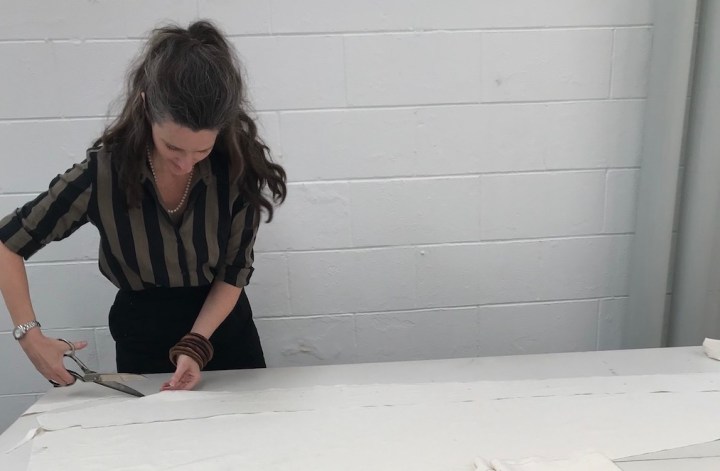
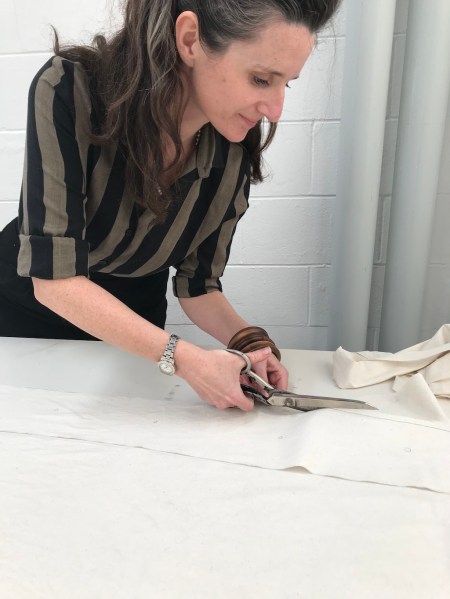
Swapping my workspace in The Hub at Otago Polytechnic for DEMO, Whitecliffe College’s project space, I completed the Coat I began for Unbound; Liberating Women.
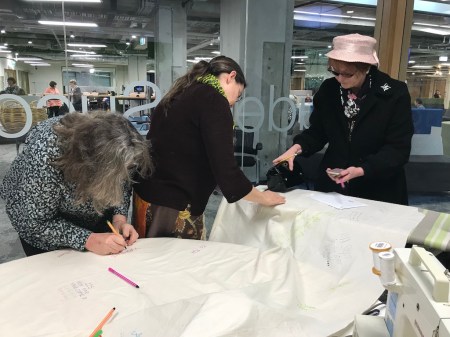
People adding their marks to the coat as it was being sewn…
During the course of the Day of Making at the Symposium, I had visitors come and see me to add to their original contribution, as well as people who attended the symposium, but not the dinner, and who wanted to participate. The conversations continued and the work went on…It was important to allow everyone time to come and go while I was there working, and share stories with me or with other delegates making their marks.
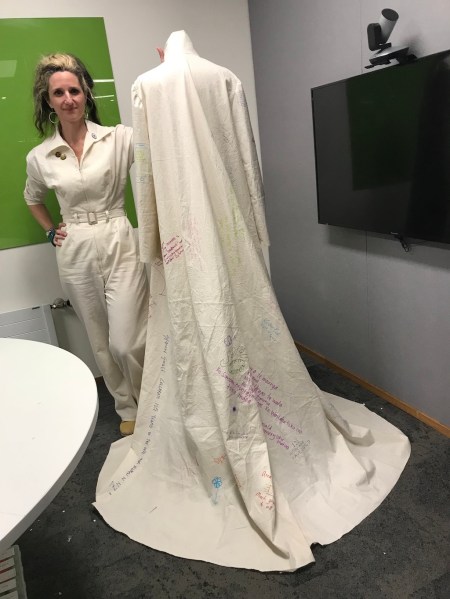
Shattered but happy
Feeling tired and frazzled by now, the outer of the garment was complete, and she was looking stunning. I needed to complete her, adding lining and hemming, so arranged another residency at DEMO, where she began as piece of calico, I had the space and a weekend. I was happy.
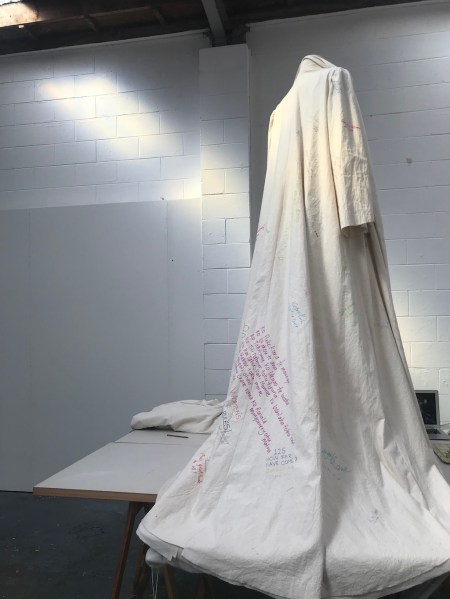
On the table to be pressed and hemmed
The choice to extend the length of the coat, beyond floor length was the right thing to do, it gave plenty of space for people to work with, and, I think gives the garment quite a presence, it also shifts it further from being a wearable object.
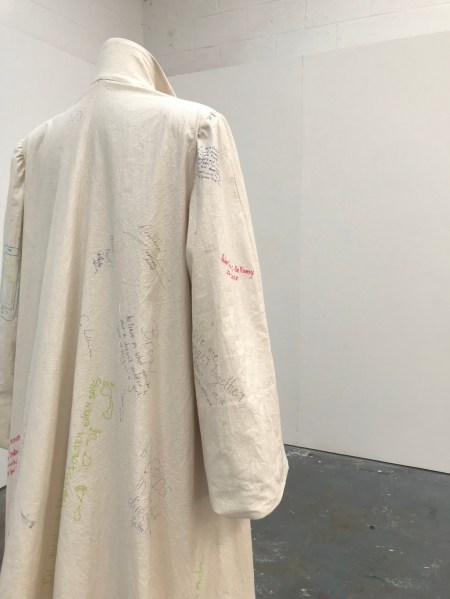
Oh look at that drape…
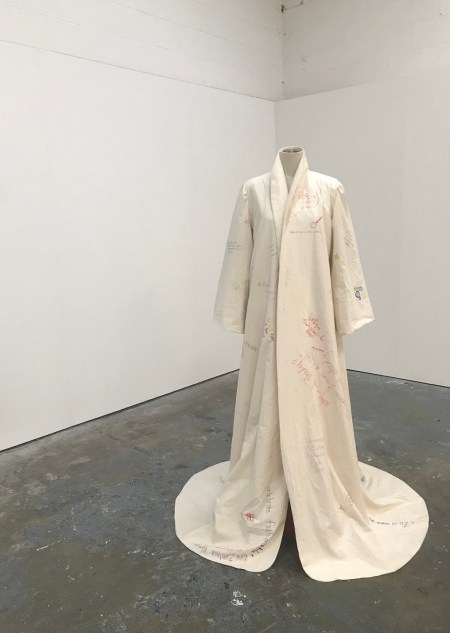
She’s standing at my height, I love the way the fabric pools on the floor
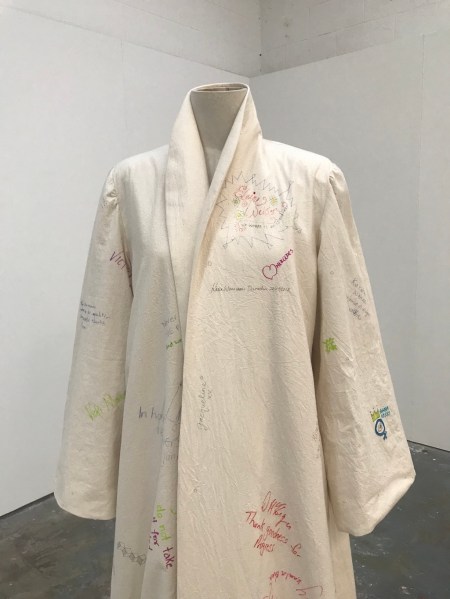
Standing tall
There are a wide range of marks, some, a simple signature and date, others a drawing, a quote or poem, or words of wisdom. I feel as though a lot of mana was infused in this object and it has been an honour to work on it and with the people who participated in the project, the enthusiasm that people brought, the intention behind the words and imagery was humbling and added more meaning to the making and the finished object than I anticipated.
This has given me plenty to mull over and consider for future projects.
Thank you….
With grateful thanks to Creative New Zealand and Costume and Textile Association of New Zealand for supporting this project, special thanks to Stella Lange for providing me with everything I needed for my sewing space at The Hub, including a very special sewing chair, and Elaine Webster for being such a gracious host and woman of wisdom.


-
Unbound: Gathering Material for Unbound; Liberating women
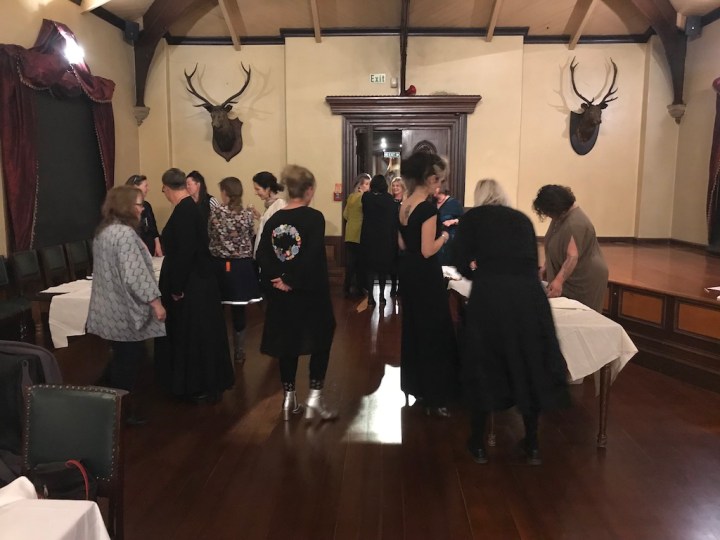

The Ballroom at Larnach Castle
Last month, September, the month to mark 125 of Women’s Suffrage here in Aotearoa New Zealand was a big month, I realised two major projects, one in Dunedin, one in Whangarei. Both were based around the idea of drawing people together to contribute their thoughts, ideas, concerns, stories or simply their signatures on pieces of a garment I would sew to mark the occasion.
For the Costume and Textile Association of New Zealand’s annual symposium, Unbound; Liberating Women the project was entitled, Unbound: Gathering Material and was based in two places over the course of the weekend; during the symposium dinner, in the Ballroom at Larnach Castle and a workspace I was given in The Hub, at Otago Polytechnic.
Following are some photographs documenting the signing of pieces of the coat at Larnach Castle. Thanks Catherine Davies-Colley for your camera work!
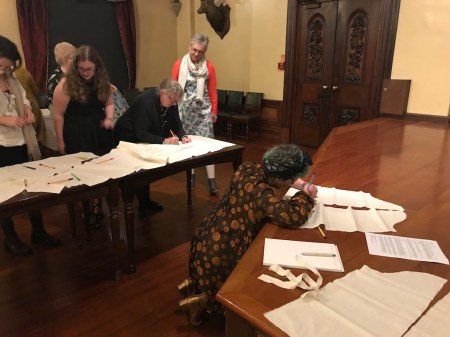
Between dinner and dessert, I invited guests to come and sign or make a mark
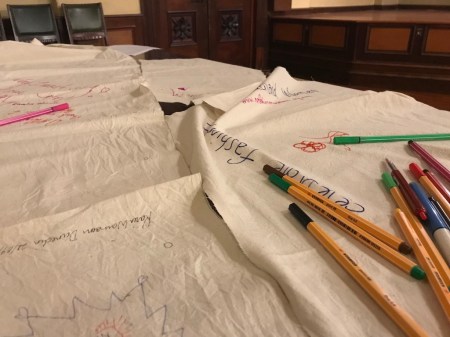
Pieces of a coat were laid out on two sets of tables, along with a variety of markers and pens
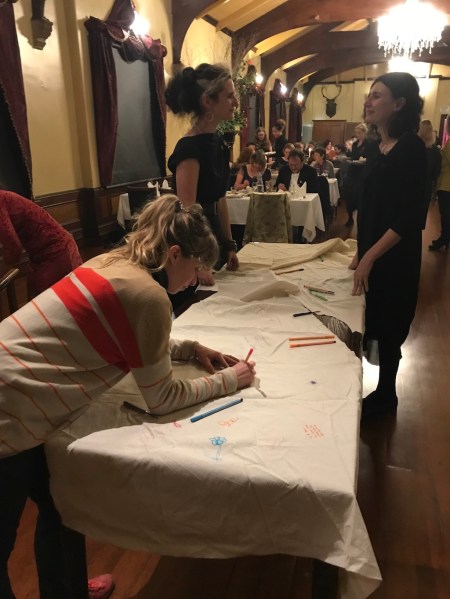
There was probably more conversation around and over the pieces of fabric than there was mark making!
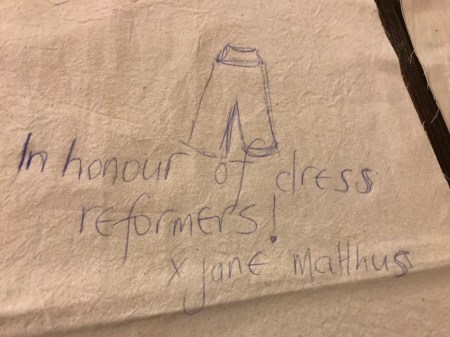
References to a paper presented and the women who pushed the boundaries in dress reform, thanks Jane Malthus!

Gathering, looking, thinking and talking
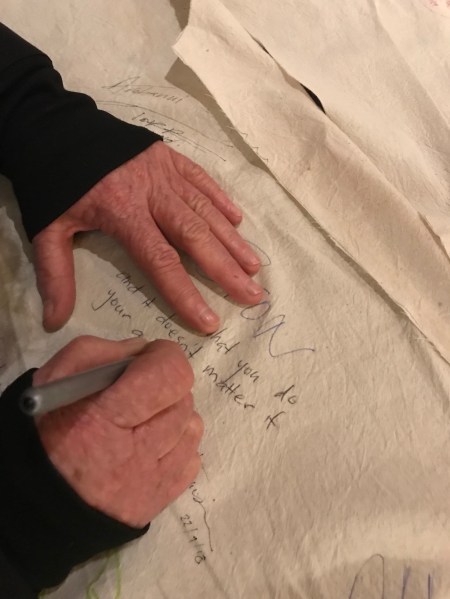
Beautiful words shared
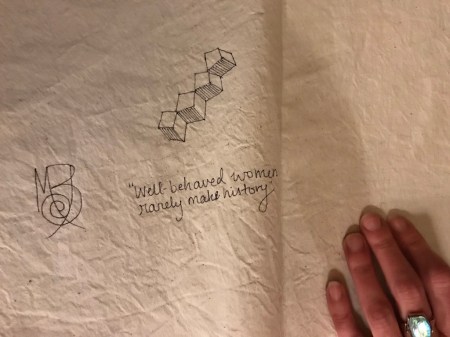
“Well-behaved women rarely make history”
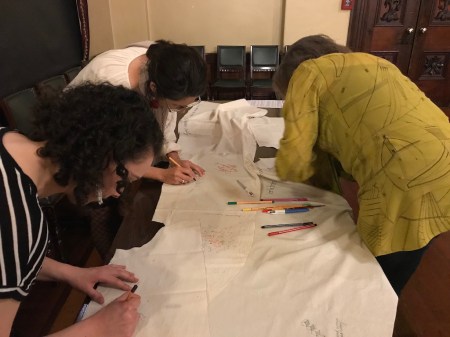
Very focused
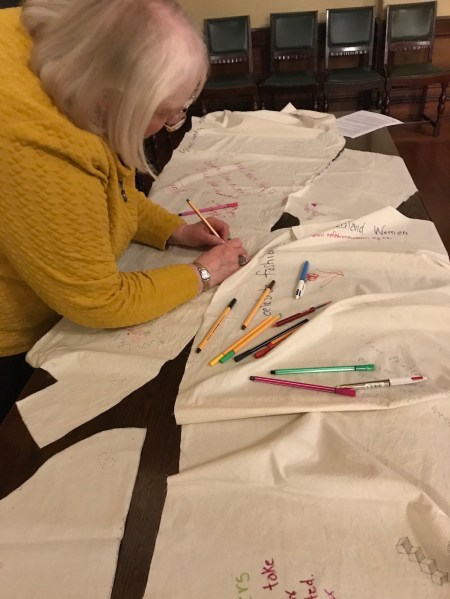
The garment pieces filled up fast, as the approximately 60 people shared in the work
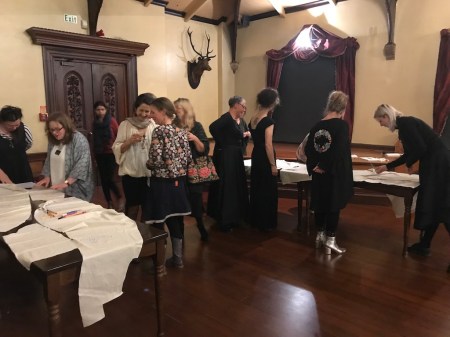
I was so impressed with the enthusiasm brought to the project

“Without land and without Women we are lost..”

So many people!
Images of the completed garment are forthcoming…..
With grateful thanks to Creative New Zealand and Costume and Textile Association of New Zealand for supporting this project, special thanks to Stella Lange for providing me with everything I needed for my sewing space, including a very special sewing chair, and Elaine Webster for being such a gracious host and woman of wisdom.
-
Unbound: Gathering material
Press release
Unbound: Gathering material, Angela Rowe
Larnach Castle and Otago Polytechnic, 21st – 23rd September 2018.
Delegates attending the Costume and Textile Association of New Zealand’s annual symposium, Unbound: Liberating Women and the symposium dinner are warmly invited to contribute to the project Unbound: Gathering material by Angela Rowe.
This project involves the creation of a garment that may be viewed as an historical document, recording the symposium as an event. It may represent a physical ‘checking in’, a common practice on social media, while the finished object becomes a tangible document of this event, a collection of autographs or marks which may represent the only time this group of individuals are present together.
How can you contribute?
You are invited to add your signature or unique mark to pieces of a garment that Angela will sew over the course of the weekend. Your participation is voluntary.
What happens next?
The finished garment, photographs and other documentation will be circulated to participants and may be exhibited in the future, shared on social media and on Angela’s blog as part of her MFA studies. This material may also be incorporated into future projects.
If you would like to stay up to date with the progress of this project, leave your email address on the sheet provided.

About Angela’s practice:
Angela lives and works in Whangarei and is an MFA candidate at Whitecliffe College of Arts and Design. Her studio research circulates around a number of themes, including performance, evocative objects and the usually private world of the home interior. Focusing on domestic concerns around care and ‘maintenance’ work, a term used by Mierle Laderman Ukeles to describe the care work she did daily as a mother, work is identified as something that is mostly hidden and taken for granted. In this context work can involve both physical and emotional labour.
For Unbound: Gathering material, her work focuses on the significance of the individual signature and human relationships, moving within the fields of social anthropology and relational aesthetics. Elements of this project reference traditional domestic tasks usually undertaken by women and suggest activities that connect generations.
This framework offers a means to understand relationships and is a way to make connections through individuals and time, using the experience of the symposium and the relationships that occur to develop narratives and acknowledge memories.
Concluding in a performance in which the garment developed is sewn to completion and the work witnessed publicly throughout the symposium, Unbound: Liberating Women, the project aims to evoke ideas around labour, the body, social relations and women’s work. These are concerns that are still relevant in 2018, as we mark 125 years of women gaining the right to vote.
MFA blog
https://angelacartermfa.wordpress.com/
Blog
Instagram
https://www.instagram.com/prettymermaidspurse/
Thank you to my generous sponsors and supporters, I couldn’t do it without you xo
My costs for this project have been covered by a Quick Response Grant from Creative New Zealand, and my equipment is being supplied by CTANZ members and Otago Polytechnic.
-
Social Bodies; Ocean of Air, in Water, a group exhibition opening next week

Water, a group exhibition I have work in opens next Thursday!
‘Ma te wai, ka ora tonu ngā mea katoa!’
Through water, all things live! Water gives life to all things!The exhibition is from 3 May – 25 June 2018, at Geoff Wilson Gallery
Northtec, Toi Te Pito Arts Precinct NorthTec
51 Raumanga Valley Road
Whangarei 0110
New Zealand is surrounded by oceans and sea and is home to many rivers and inland waterways. This environmental fact inspired the group exhibition Water, hosted at The Geoff Wilson Gallery, Northtec, Whangarei.
The exhibition features works by twelve artists each responding to the notion of water via an image, sound or sensation. Represented are discussions pertaining to the qualities of water albeit; beauty, environmental challenges, cultural discussions or water’s sensual and erotic nature.
Participating artists include: Angela Carter, Benjamin Pittman, Brenda Briant, Denise Batchelor, Emma Smith, Jill Sorensen, Linda Cook, Lydia Anderson, Martha Mitchell, Natalie Robertson, Robert Carter and William Bardebes.
A calendar of events, workshops, lectures and discussions, will accompany the exhibition as Water runs its course through May – June.
Curator – Linda Cook

Social Bodies; Ocean of Air, installation, and opening night engagement.
“…We live not, in reality, on the summit of a solid earth but at the bottom of an ocean of air.” – The Invention of Clouds, by Richard Hamblyn (2002).
Using garments as signifiers, as tools of socialisation, communication, and belonging; Social Bodies; Ocean of Air invites the gallery visitor to step into an other world. The objects in this exhibition are activated when worn within the space, the viewer~wearer becomes part of the social experiment, bringing them to life, adding meaning and their own story to the garments.
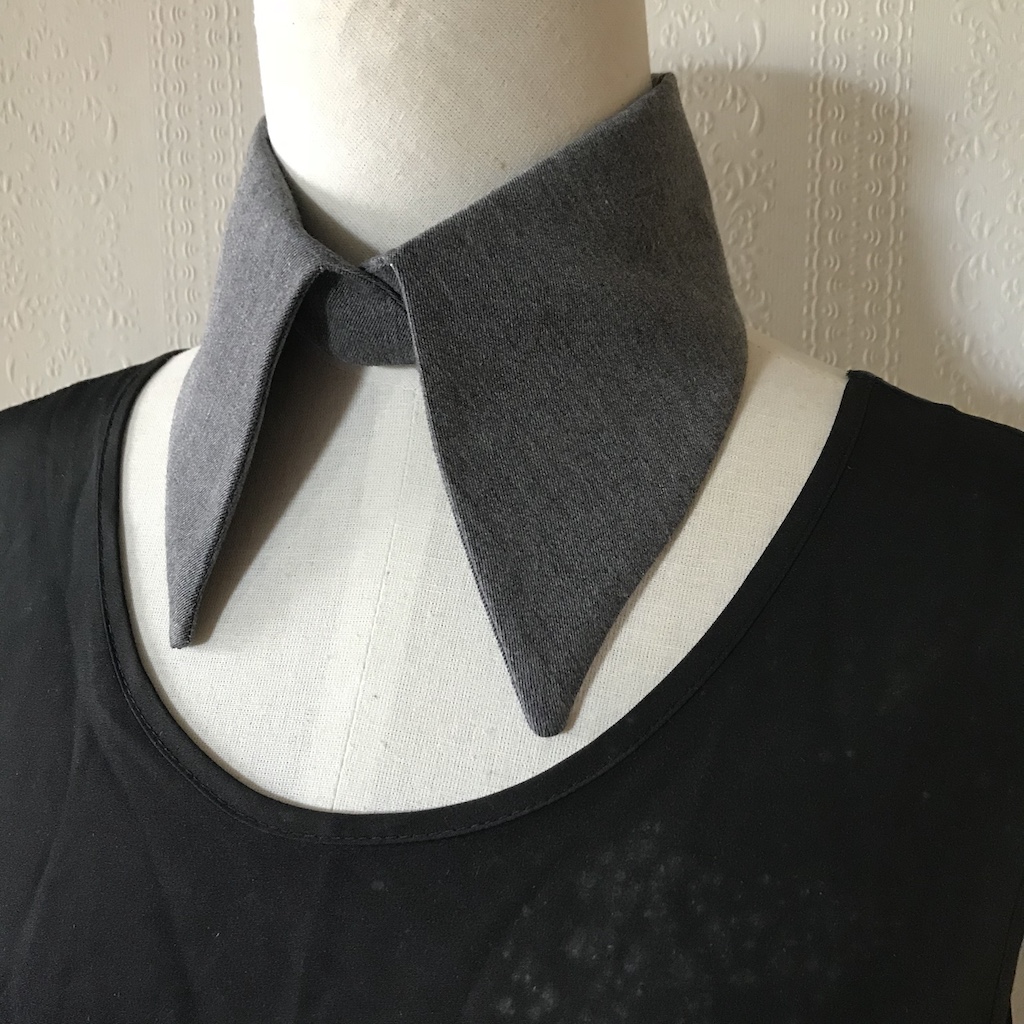
Social Bodies; Ocean of Air, detail.
Visitors are invited to consider; what is your relationship with this Ocean of Air? And how do you navigate it? You are invited to use the objects in Social Bodies; Ocean of Air as tools for communication, play and ‘dressing up’.
Everyday dress is a performance…will you play along?
“Fashion is thus representative of both social and cultural performances, since the ways in which our bodies are clothed is imbued with socially constructed meanings, especially in regards to gender. Fashion also acts as both a cultural and social symbol, operating under the overarching cultural conventions defined by dominant systems of power. Within clothing are the possibility for constructing power and influence, and a space for dissent, critique, and exploration.” (Neumann, 2011).
References:
Hamblyn, Richard. The Invention of Clouds: How an Amateur Meteorologist Forged the Language of the Skies. New York: Picador, 2002
Neumann, Jessica, “Fashioning the Self: Performance, Identity and Difference” (2011). Electronic theses and Dissertations. 475. https://digitalcommons.du.edu/etd/475
-
Free Speech at Demo this Thursday!

I have some work in a group show opening this week in Auckland! Full details below…
If you follow me on instagram, you might have noticed I’ve been busy stitching, I have a piece that grew out of my nana’s shorthand note book, it’s been many, many hours of fine work, read more about the note book and my studio research here on my MFA blog. There are heaps of other artists, so there will be plenty to see, especially at the opening!
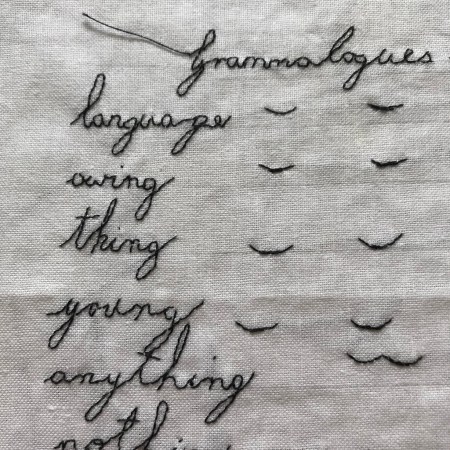
Exercise 45, 2018, detail, Grammalogues
The exhibition FREE SPEECH is a selected show by a small team of students and staff working on Whitecliffe’s MFA programme, that focuses on the use of text as, and in artwork.

Exercise 45, 2018, detail, your, year
The exhibition includes works in paint, digital and screen print, drawing, photography, video, sound, found objects, textile, performance and sculpture. Artists include Mary Louise Browne, Rachel Caddy, Angela Carter, Gerard Copas, Elliot Collins, David Cowlard, Veronika Djoulai, Julie Downie, Matt Ellwood, Justine Giles, Noel Ivanoff, Oliver King, Felixe Lang, Richard Maloy and Billy Apple, Gina Matchitt, Emil McAvoy, Tiger Murdoch, Caroline Powley, Christina Read, Deborah Rundle, Kate Russell, Marie Shannon, Glen Snow, Rebecca Steedman, Imogen Taylor and Alan Thomas.
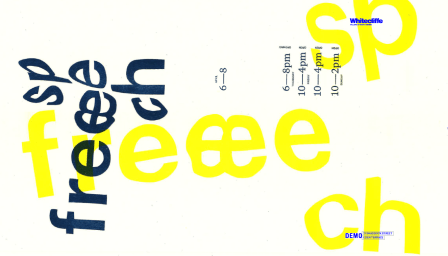
The poster image is of one of a suite of Risograph posters produced by Rebecca Steedman for the exhibition.
The exhibition’s opening event is generously sponsored by Toi Toi wines. Please join us to celebrate the opening of FREE SPEECH on Thursday, 5th April between 6-8pm at DEMO, 21 Shaddock Street, Eden Terrace, Auckland.
-
First contextual assignment from On the Smallness of Things

This post was originally published as part of the contextual component of my Masters in Fine Art, and you can find it here. I will share occasional content from my study blog, On the Smallness of Things from time to time. My study blog is where I share work in progress, research and themes I am working on, here, on Mermaids Purse, you’ll still see my work, just more resolved projects.
Assignment one, due 5 March 2018

On the Smallness of Things, Coats Cotton on cotton nappy, 2017
What do you do? What sort of things do you make?
I work with my hand and eye, using materials I have at hand, often following principles of Arte Provera, but not bound by this if I feel it’s important to executing my idea. I often work with stitch and fabric. The objects themselves vary; some items are recognisable, alluding to forms seen in the natural world, these works come from study and research of fungi, lichen, and biological growths. Other things I make relate more directly to my life, I make things to understand what has happened, what is happening, representing experiences, memories, such as my difficult dolls and work with hospital textiles. I also create items of adornment, or items that may be worn, or not; I make clothes for myself and wear them, sometimes this is a performance. I am interested in the daily performance of life, with elements of theatre and contrivance at and also the mundane repetition that is also part of life. I make things, objects, about the process of making garments, and value the skill involved in producing everyday objects that are often taken for-granted.

Understanding lichen, drawing on fabric, 2016
What is it you’ve been trying to do to make the work relevant in relation to ideas, cultural circumstances or contemporary issues?
My work is at times reactionary, yet grounded in solid values; such as work around fungi, Mycelia/Mycelium, which connected to social and political concerns relating to the housing crisis in Aotearoa. By exhibiting, writing and talking about this work, I connected it with contemporary social and political issues. Other work, I find more challenging to keep relevant, my work in response to or against motherhood is more fraught, I read and follow other artists who are mothers working in this area. But I feel like it is ‘othered’, by myself at times. This duality is expressed well by another mother: “…motherhood is a state in which you constantly feel lonely and yet you just want to be left by yourself” (Castagna, 2015). I also read widely and aim to attend exhibitions, and write about my work, I incorporate workshops or artist talks when I exhibit, which helps to keep my work relevant, or tested with a wider audience.

Mycelia:Mycelium, 2017, keeping it real, children’s workshop
How do you make decisions during the course of your work? How and why do you select the materials, techniques, themes that you do?
I start with an image, place or experience, I am driven by curiosity, to find answers or understand ideas, and I mostly use what I have to hand as a starting point in my making. I am seduced by materiality; objects, textures and sounds influence my work, such as cleaning and clearing my grandparents home, I was confronted by the familiar with a new purpose, and saw objects subjectively, but also profound memories were attached to them. This brought me back to the materials and objects of my daily life, and the women who came before me. My life and my work – making, are entwined and I cannot separate them, and I find myself working with material and ideas that are part of the domestic realm, the Interior, that relate to care and connection.

Hand stitching on Nana Joy’s golden quilt, 2017
In reviewing Annie Mackenzie’s Walking Forwards Backwards, 2016, an installation which included handwoven pieces that mimic cheap tea towels, Jane Ruck-Doyle describes how remaking a familiar object subverts contemporary consumption and our understanding of the everyday:
“These skilfully made pieces reveal close attention to detail, and deliberately mimic mass-produced cloths that are highly familiar – ones found in packets of three held together with a plastic tie and sold for a few dollars. These cheap and useful items have textured stripes to evoke the appearance of traditionally woven cloth – through remaking them by hand, Annie draws heightened attention to everyday objects and both reclaims and highlights the artistic and cultural value of the handmade.” (Ruck-Doyle, 2018).

Nana Joy’s mended hanky
I feel a meaningful connection with domestic materials, which I am drawn to touch and manipulate, and also want to keep at a distance. My making and reading feedback on each other, sometimes I am driven to master a new technique or recreate or make a response to something I have read or seen. Some of my projects develop over long periods, with breaks for new explorations, then I revisit a project with fresh eyes, or new skills.
Why have you created the work you exhibited and what is its history?
I work to understand an idea, test a form or material, talk about something I care about, this may be personal / political / social. When I reflect on past projects and exhibitions, such as There May Be Some Repetition, which includes multiple handmade dolls made from hospital gowns, and an embroidery on a hospital sheet, I am using the material and objects to communicate a – story – idea – concern. With this work, I was working to understand and speak to the experience I had in hospital, as a child and later as a parent, in hospital caring for my own child. I work regardless of a deadline to exhibit or present my work, I pursue projects, making objects, or reading to learn, usually more questions and ideas are revealed.

The first Hospital Doll, including clothing, made from a hospital gown, 2016
The history of the making of my work is related to my life experience, I often develop work over extended periods of time. I feel as though I’m working to give meaning – acknowledgement ? to what might remain hidden or ignored, private.
The history and associations within my work may be further complicated by choice of materials, such as home textiles, curtains or blankets which have had a life, I don’t attempt to hide this in the new mode. The forms, such as curtains or garments may bring further associations, around softness, impermanence, ‘feminine’ objects.

Nana’s hospital lunch, Smooth Puree 3 (With Snacks) 2017.
What are you trying to say in the work?
For my current project, a piece for a group exhibition entitled Water, I’m am making a collection of object-garments, representing fragments or ideas of something familiar, which I will invite gallery visitors to engage with, to try on, and to wear. I want people to have fun, I want people to try these pieces on and consider how the way they dress might change their ‘performance’ of life. I would like to see if people connect via the garments, see other people wearing them, and then, what happens?
“Convention, with all its trappings, is just another kind of performance.” (Searle, 2018).
I wish to start a conversation in the space of a gallery around identity, increase awareness about habits of adornment, how what we wear helps us express ourselves. Telling the world, our interests and values, aligning ourselves with a group, or placing ourselves in a class. How our choice of garments becomes a kind of shifting self portrait, through aspirational qualities of clothing and garments as social makers, class, and identity.
How is the way you are saying it, with the materials, techniques and themes, the best for the idea you want to present?
I am working around methods of display to invite participation, using one fabric, to create a sense of unity and multiplicity. It is the interaction I hope to facilitate, between these objects, and gallery goers, staff and myself that is fundamental to realising the ideas and opening up the conversation. This is a kind of social experiment.
“Dress is the form, it’s the major form, in which we make our bodies social”. (Entwistle, 2017).

How does your current work relate to your previous work?
The project for Water is a leap outside my practice so far; it will utilise my skills and experience with materials and making, with the increased direct social connection and deliberate physical, hands on interaction between my work, the gallery visitor, and myself.
However, it seems to me like a natural progression from curating my own wardrobe and constructing an identity by creating my own garments, some utilitarian responses to my lifestyle, others more aspirational.

McCall’s Black Dress, May 2017
It is an extension of the work and research I have done in understanding garment construction and design, along side ideas around how garments and clothing are used as social and communicative tools, and as a form of self expression. While the methods of making are inline with my values of the handmade, and process, it is what happens within the gallery space that I will be focusing on.

Crustacea, part of Woolon 2017
This is also connected to social and environmental concerns I have around patterns of unsustainable consumption, specifically related to the fashion industry. This reaches into very personal choices and self expression, I’m interested in how people disrupt and push back against the fashion industry.
What influences your work?
Contemporary concerns, around the environment, consumption, and identity. Currently, exploration of ideas around dress and identity is taking me into historical and contemporary exponents of dress reform. These include early dress reformists, who rejected constrictive underwear and voluminous petticoats which was heavily linked to women’s emancipation in the 19th century (Schoeny, 2000), to artistic movements from Russian Avant Garde in the 1850s – 1930s (Stern, 2004).
Saying goodbye letting go, Wind at Poppa and Nana’s, 2017
It is also my day to day life, and the relationships I have with everyday textiles that influence my work. There appears to be an abundance of textiles around me, as garments, homewares, objects I care for on behalf of my children and extended family. At times of transition, change or crisis, I observe the situation and the details to either distract or to ground me in the moment, such as clearing my grandparents home.

Most of Nana Joy’s handmade quilts, 2017.
What is your inspiration for your images?
I source ideas for imagery from the everyday, using materials and situations that may be familiar. For example, while clearing my poppa and nana’s home, I was struck by the volume of curtains, linen and “soft” homewares that were stashed in closets and wardrobes. This gave me pause to consider my nana’s childhood during the depression (nothing is wasted, repair, reuse, repurpose), and brought up ideas around use of net curtains in the home; to conceal/to reveal, so I began playing with these as a material to use them in unconventional ways, specifically on the body, or create objects that suggest a body.
Changing the context, bringing these objects outside I could see traces of the original, as well as bringing up other concerns about the body, or it’s absence, and movement verses static presentation.

Capsule Wardrobe experiments, 2017
I also draw inspiration from the process of making, which is something of a hidden world when it comes to clothing the body; in the community around me, there seems to be a clear shift from producers to consumers, a whole language around the craft of construction is lost. So, I am interested in what this language looks like.

Raderblad (pattern), circa 1950, photograph, 2017

Construction of bound button holes, Vintage Suit Sew Along, 2016
How does this work fit into a larger body of work or overarching project?
The project for Water is shaping up to be a progression into a potential project examining the self and identity as expressed through garments as self portraits and performance. Possibly how dress informs or creates an identity. This is an extension of my work in curating and performing my own identity through my wardrobe, how garments affect my sense of self, and how I may begin a dialogue with others, in a gallery setting or other space. This could be about the objects, the garments, and the messages they bring, or it could be portraits of this ‘self’ constructed through the objects.
How did your idea change (if it did)?
I shifted my focus, by making my piece for Water a performance. I decided to become an active participant and make the project specifically about engagement and participation with the viewer.
My ideas are always shifting, though. I must change with the materials I have at hand, and the shape of my life and time available. When I am working with short bursts of time, I may work on smaller, portable projects, like embroidery. Reserving larger projects, or planning and prepping to periods of time when I give full attention and focus to execute an idea in my work.
Looking beyond Water, I have a range of ideas that I will investigate.
Has anyone done this kind of work in the past?
Many people have worked with these ideas, some that resonate right now follow.
Exploring dress and fashion as identity:
Early rational feminists viewed dress reform as essential to women’s emancipation, adopting The Bloomer Costume and Emancipation Suits (Schoeny, 2000).
Futurist, Constructivist and Suprematist artists in the early decades of the 20th century pioneered attire inline with the values of their respective movements. Often aspiring to create a single garment for life, which aesthetically amplified their message and improved life (Radu, 2005). Some were minimal in the extreme, resembling a well padded (and pocketed!) boiler suit or, unacceptably to the socialists, the American style overall. Others were vibrant, and expressing movement, as in simultaneous garments created and worn by Sonia Delaunay (ibid).
They included Giacomo Bella, Sonia Delaunay, Gustav Klimt, Kolomon Moser, Aleksandr Rodchenko, and Varvara Stepanova.
Artists who perform
Sriwhana Spong – using costume:
http://www.blackmagazine.co.nz/blk-list/sriwhana-spong/
Ana Mendieta – the body
https://www.theguardian.com/artanddesign/2013/sep/22/ana-mendieta-artist-work-foretold-death
Elsa Dorfman, portraits, self portraits
Lenka Clayton
Initiator of the Artist Residency in Motherhood, works across a range of media, this piece resonates with me, with regards to my current practice with garments, history and marks of the maker.
http://www.lenkaclayton.com/work/#/handtyped-check-shirt/
Does anyone else do it now? Who are the artists that occupy this terrain?
With regards to performance and social practice:
Melissa Laing, with her Boat Date project performance, where a person can book to be taken a boat ride with Laing and have a personal experience with her. Conceptually, I relate to her use of her handcrafted boat, The Question Put, and using The Question Put, as a means to connect with another person, perhaps in the way dress is a means of communication and possibly connection.
The Rational Dress Society, declaring on their website:
JUMPSUIT
An experiment in counter-fashion
Brought to you by the members of
The Rational Dress Society
The Rational Dress Society promotes their individually designed jumpsuits, made to measure and shipped to the buyer, they are also creating an open source pattern to download, and sew your own jumpsuit (Rational Dress Society, 2018).
Andrea Zittel has created several projects around a ‘uniform’, in response to social dictates around fashion. These include Six Month Uniforms, A-Z Uniform Project, and other iterations which explore minimum waste garment construction techniques. Her website describes her practice within An Institute of Investigative Living as:
“the A-Z enterprise encompasses all aspects of day to day living. home furniture, clothing, food all become the sites of investigation in an ongoing endeavor to better understand human nature and the social construction of needs.”
Who are the writers on these subjects?
Calefato, Patrizia. The Clothed Body. Oxford: Berg, 2005.
Geczy, Adam, and Vicki Karaminas. Fashion and Art. London, UK: Bloomsbury Academic, an Imprint of Bloomsbury Publishing Plc, 2013.
Ryan, Zoë. Fashioning the Object: Bless, Boudicca and Sandra Backlund. Chicago: Art Institute of Chicago, Yale University Press, 2012.
Stern, Radu. Against Fashion: Clothing as Art, 1850-1930. Cambridge, MA: MIT, 2005.
Truitt, Anne. Daybook, the Journal of an Artist. New York: Scribner, 2013.
Wilson, Elizabeth. Adorned in Dreams: Fashion and Modernity. New Brunswick, NJ: Rutgers University Press, 2003.
Dr Vicky Karaminas on Fashion and Uniforms:
Other readings:
Barnard, Malcolm. Fashion as Communication. Florence: Taylor and Francis, 2013.
Hamblyn, Richard. The Invention of Clouds: How an Amateur Meteorologist Forged the Language of the Skies. New York: Picador, 2002.
Ryan, Zoë. Fashioning the Object: Bless, Boudicca and Sandra Backlund. Chicago: Art Institute of Chicago, Yale University Press, 2012.
Podcasts, youtube and symposia:
Fashion and Physique at FIT, popular culture and the female body, the fashion industry it’s impact on our relationship with out bodies and identity.
http://www.fitnyc.edu/museum/events/symposium/fashion-physique/index.php
Clare Press’ Wardrobe Crisis podcast, steaming from her book of the same name, this includes interviews with designers, artists, activists, scientists and garment workers. Unpicking issues around consumption, our bodies, why we wear what we wear, and what people are doing to challenge current patterns behaviours.
https://www.clarepress.com/podcast/
Contemporary Feminism; A series of panel discussions at the City Gallery Wellington in the context of the exhibition Cindy Sherman.
https://www.radionz.co.nz/programmes/contemporary-feminism
Is Fashion Art?
Valerie Steele giving the keynote speech “Is Fashion Art?” at the mumok, museum of modern art Vienna.
Is your field an established one or did you have to invent it?
My work is situated across multiple fields, including social practice, performance, activism, and art / fashion. Most fields that I may place my work in are understood and respected within accepted modes of ‘Art’. When my work is located in the area between Art and Fashion, it seems to be illegitimate offspring of costume and performance, not quite art and not quite fashion.
I would like to continue to work through the space between art and fashion, establishing this further this as a legitimate field of research and expression. At times, working in materials such as textiles, embroidery, or stitch, means that I can position my work in multiple fields, it can be relatively accessible in gallery context as these modes of practice are so familiar within the field of craft. At the same time, installing work that is associated with handwork, textiles or fashion within a gallery can be more problematic, raising questions like, ‘what is art/craft/fashion?’, ‘who decides?’, ‘where do I put this work, if not in a gallery… then where?’.
References
Castagna, Felicity. “Who Gives a Shit? On motherhood and the arts”. Southerly Journal. November 25, 2015. Accessed February 25, 2018. http://southerlyjournal.com.au/2015/11/25/who-gives-a-shit-on-motherhood-and-the-arts/
Entwistle, Joanne. “The Body: Fashion and Physique, Interviews.” Youtube Video, 8.06. December 5, 2017. https://www.youtube.com/watch?time_continue=14&v=ZfYyXyMF4I0
Laing, Melissa. Loose Canons: Melissa Laing. The Pantograph Punch. February 16, 2018. Accessed February 25, 2018. http://pantograph-punch.com/post/loose-canons-melissa-laing
Rational Dress Society. 2018. Accessed February 26, 2018. https://www.jumpsu.it/
Ruck-Doyle, Jane. Committed Passion: Handweavers Guilds and a New Generation of Makers in New Zealand. The Pantograph Punch. February 5, 2018. Accessed February 26, 2018. http://pantograph-punch.com/post/committed-passion-handweavers
Schoeny, Marlise. Reforming Fashion, 1850-1914: Politics, Health, and Art. Historic Costume & Textiles Collection. February 17, 2016. Accessed February 25, 2018. http://costume.osu.edu/2000/04/14/reforming-fashion-1850-1914-politics-health-and-art/
Searle, Adrian. “What a performance gender is! – a century of cross-dressers.” The Guardian; Art and Design, Photography. February 23 2018. Accessed February 26, 2018. https://www.theguardian.com/artanddesign/2018/feb/23/cross-dressers-gender-photographers-gallery-london
Zittel, Andrea. “Works.” A-Z; An Institute of Investigative Living. 2014. Accessed February 26, 2018. http://www.zittel.org/.
Stern, Radu. Against Fashion: Clothing as Art, 1850-1930. Cambridge, MA: MIT, 2005.
-
Academy 3568 in cream linen

Sometimes one is not enough, especially when it comes to a vampy collared dress like this, Academy 3568. I whipped it up for a frock party last year, and I needed to make another.

Academy 3568
I needed a something slightly more casual, still the dramatic collar and silhouette, but more easy going, summery, daywear rather than Evil Queen meting out justice. I had this simple cream woven linen in my stash, with just enough for the same quarter circle skirt. I had planned to add sleeves, but opted out, as in Northland, it is just too hot and humid. I may attach them later…
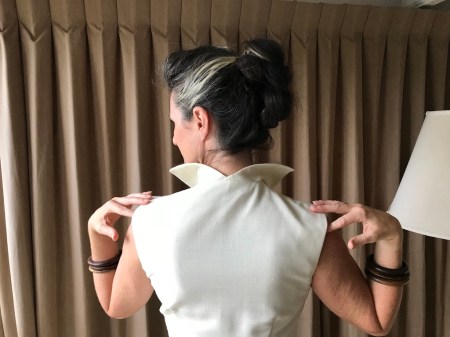
With a collar like this, I mean, who wouldn’t want more?
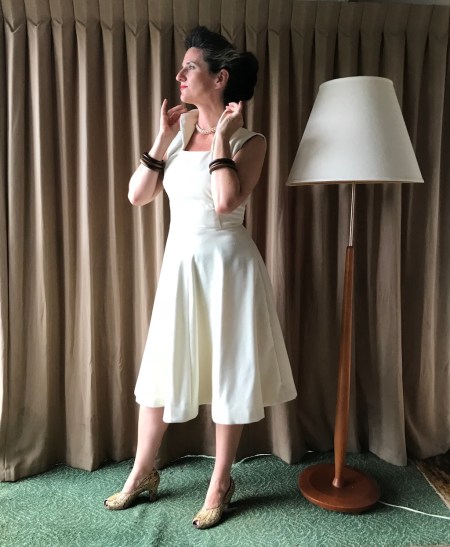
Academy 3568 and matching lamp
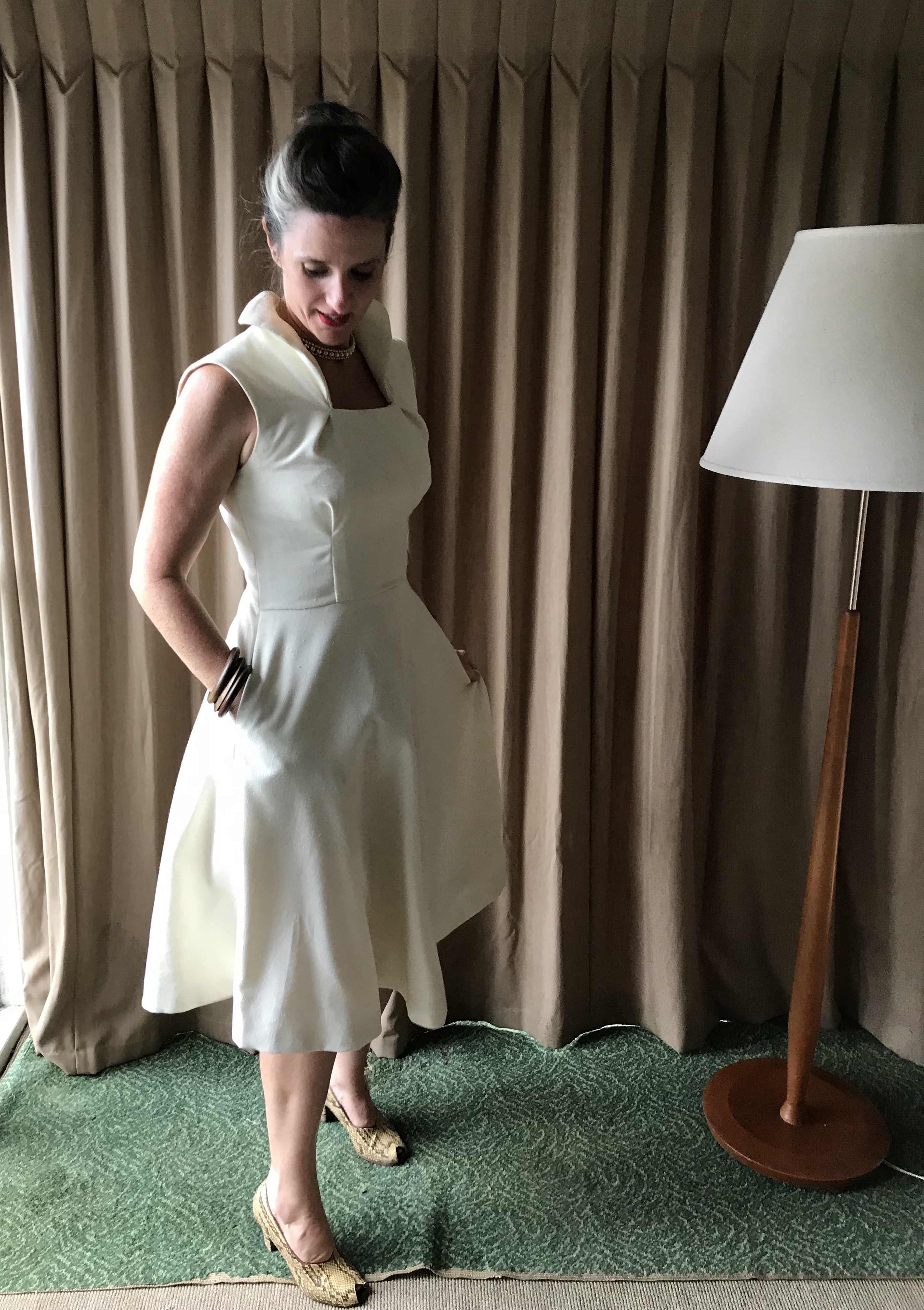
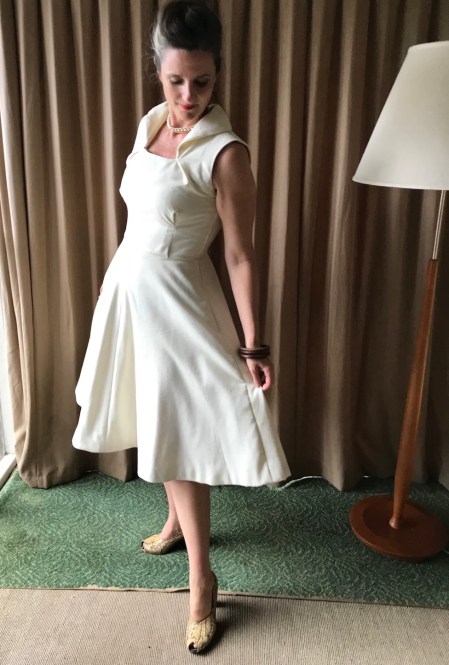
Academy 3568
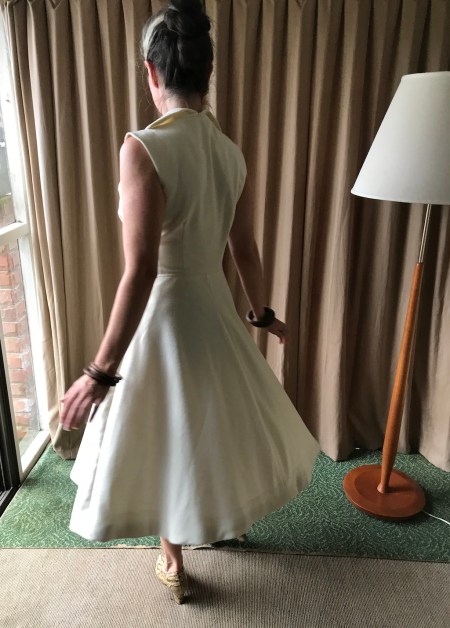
Great skirt for swirling
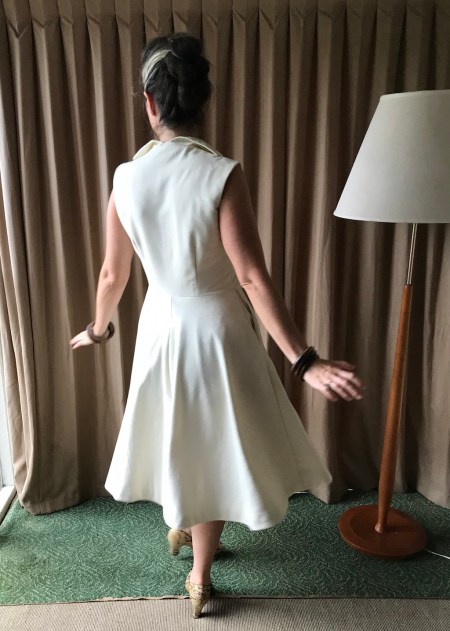
Academy 3568 in cream linen
I added a massive pocket to this, as I did the first version, I also added some heavy bais strip to the hem, this was a bit of an experiment, I think it might be a bit heavy, but still helps with the shape and structure of the hem. So, I’ll keep it for now.

Mmmmm pockets
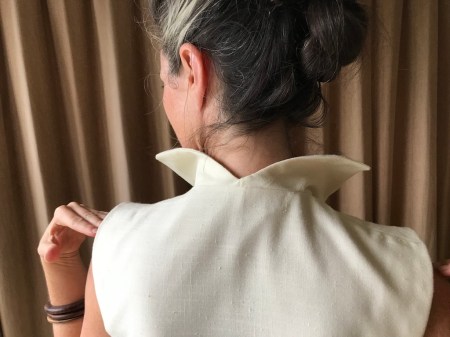
Academy 3568, that collar again
For this version, I opted for my usual iron woven interfacing for a softer shape, and easy of washing, it still sits quite well, not as high, more of a flat shirt collar. Eeep, and I do love this one too.
-
Academy 3568 in Jacquard

Academy 3568
I picked up this little treasure while opshopping last year, one of those 50c finds, which rarely happen these days. I used it to quickly whip a frock for Rock the Frock, a fundraising party for our community radio station, Beagle Radio (which is choice).
I used a beautiful Jacquard fabric that a friend destashed my way (thanks Jenn!). The fabric was truly meant for this dress, it had enough body to pull off that vampy collar, plus that shimmery sheen that gave it a slightly sci fi quality.

Academy 3568 in progress
To get the right structure, I used hair canvas, which I use in tailoring, for the collar, and added a wide strip of bias cut hair canvas in the hem of the skirt, adding structure and width without the weight of more layers. I have used this technique before in my McCall’s black dress.
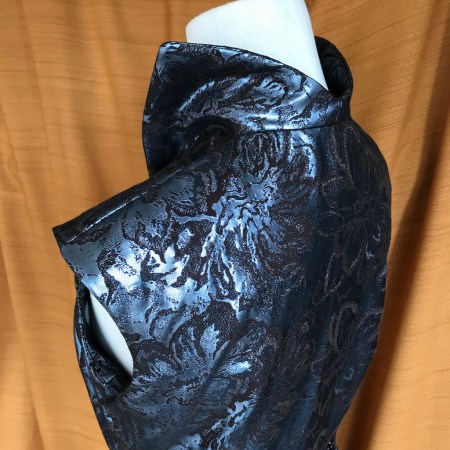
Academy 3568, that collar!
The pattern had been cut, so I had to redraft part of the shoulder to the sleeve, extending it out to the shoulder point, the pattern also called for a full circle skirt, which I did not have the fabric for. I used a quarter circle skirt instead, I also dropped it to the floor, for, well added drama! I gave the back of the skirt a touch more length too. I really love this dress.
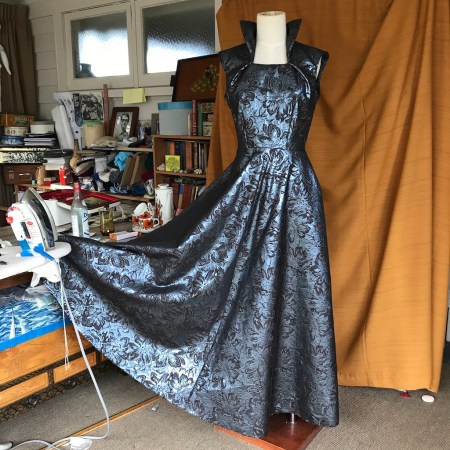
That skirt! The bias hem gave it more body.

Ayi ayi ayi, this neckline!
As you can see I also omitted the button down shirt front, this was partly a time saver, but I also think the shirt front is ultimately more casual, which is not the look I was going for…the canvas interfacing works so well!
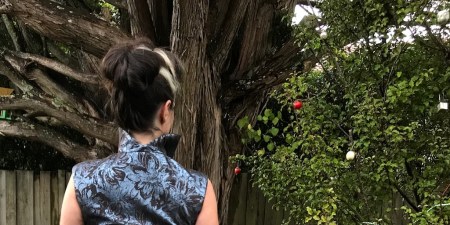
Oooh the back of the collar!
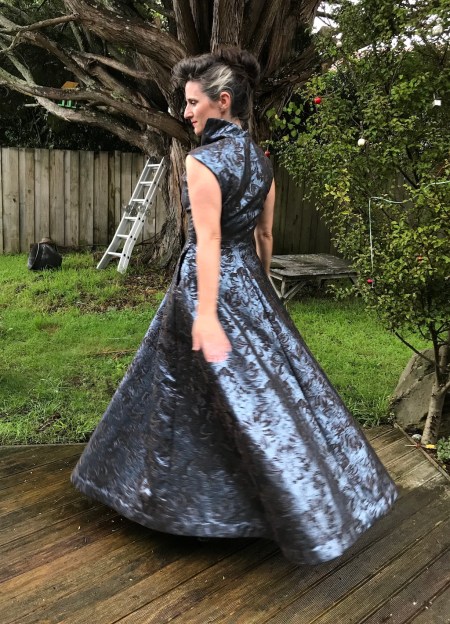
Perfect for swirling
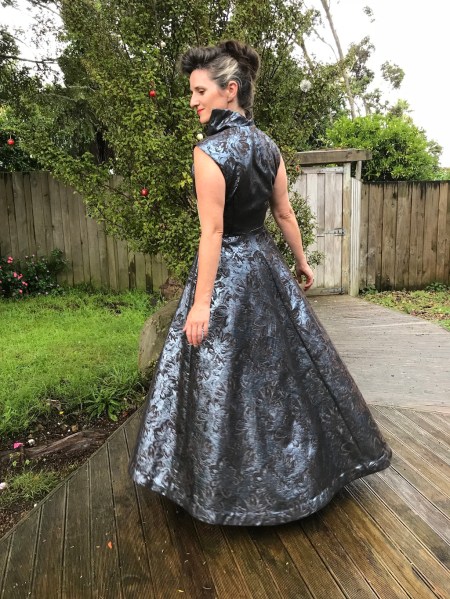
Academy 3568 in Jacquard
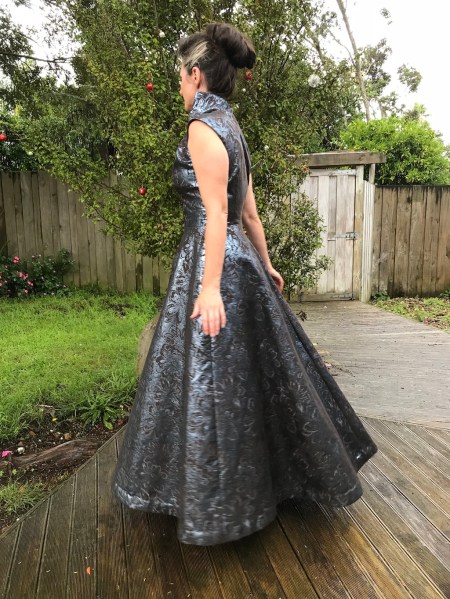
It has been raining day and night for nearly a week, there was a short reprieve today…
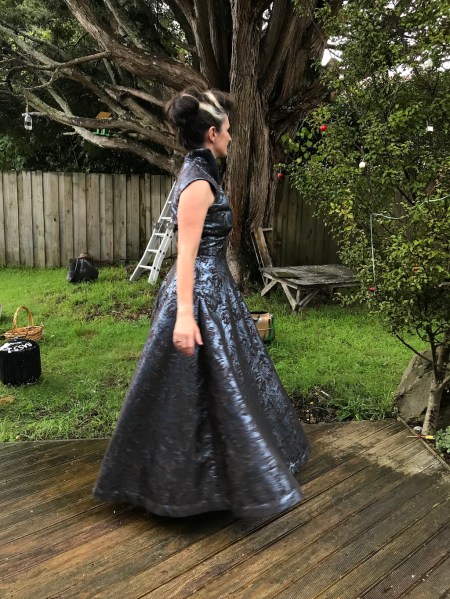
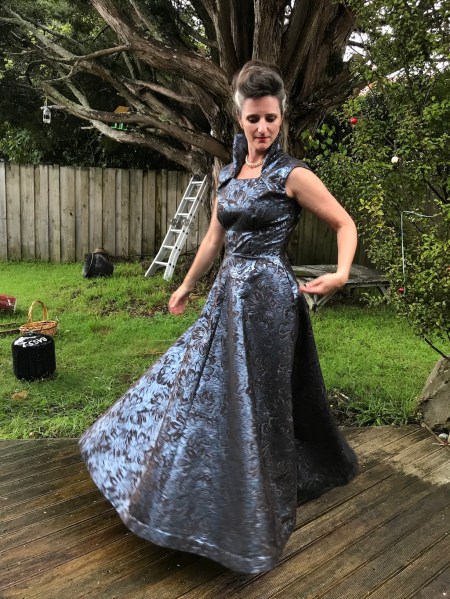
Slightly unusual dance moves

This is almost my last make for the 2017 Vintage Pledge, I’m too late getting this baby in! But love it anyway. I love it so much I had to make another one to take out more often….
-
On the smallness of things, and Where I wander in the Night, at Megan Dickinson Gallery

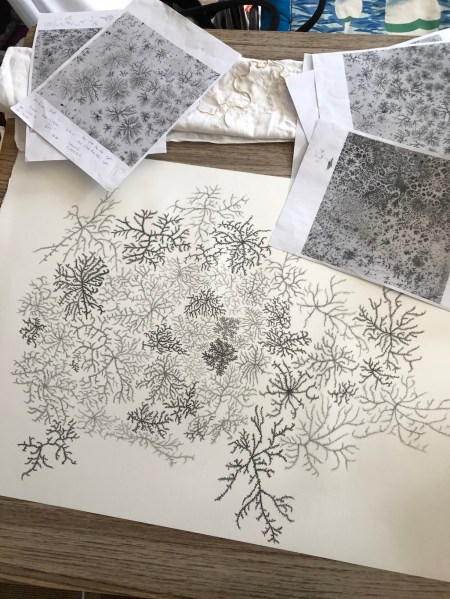
Working on Where I wander in the night
A drawing, Where I wander in the night and a hand embroidery, On the Smallness of Things are two works I have had in group exhibitions at a new dealer gallery in Whangarei. Started by Megan Dickinson, MD Gallery is the only dealer gallery space in Whangarei, and such a good initiative! You can find the facebook page here.

On the Smallness of Things
I have been yearning for an artist run space, or a progressive gallery or collaborative maker space since moving here. There are people doing cool things, and a thriving community of artists, making cool and thoughtful work, but if you are not making art for tourists, or making ‘paintings’, ‘sculptures’ or traditional art forms, there is almost nowhere to present your work.
Both the drawing and embroidery emerged from work I have been doing with lichen and other biological and mineral growths (such as Dendrites). I love the connections and chaotic density in the lichen, the patterns of growth and structure are reproduced around me all the time.

On the Smallness of Things, detail
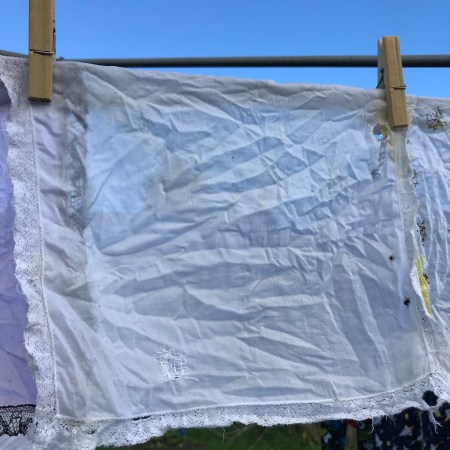
A bit more background on the embroidery, it’s worked on an old cloth nappy I found in an opshop, that was beautifully clean and white, but had patches of wear, it is almost going into holes in some places. The stitches in some places pull on these holes, (it’s hard to see in the photos) so sort of the opposite of mending (I had also been looking at the culture of mending and repair, and found some beautiful examples of my nana’s mending on her hankies).
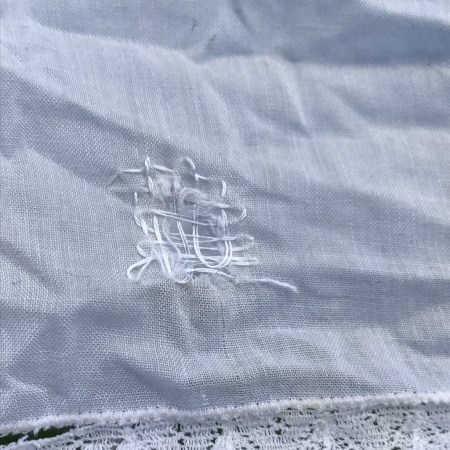
Nana’s carefully mended hanky
Structurally, I have build the embroidery using stitch, and create areas of tension in some places, pulling on the holes that existed in the original textile. The forms are likened to bacterial growths, worms, lichen and algae, some viewers have seen this as a petri dish, this is work I will continue to develop…

On the Smallness of Things, detail
-
The Costume Designer: Edith Head and Hollywood at Bendigo Art Gallery

Wall of costume design sketches, Image; supplied
While planning my dream trip to see the House of Dior exhibition at the National Gallery of Victoria I discovered that Bendigo Art Gallery had an Edith Head exhibition on at the same time. I decided to make a day trip out of Melbourne to check it out and I’m SO glad I did. I took about five hundred photos (cough) and I’ve sorted through them, and included details about the costumes, films and actors who wore them, all this is available in the exhibition and the catalogue.

Audrey Hepburn’s cream suit from 1957’s Funny Face, image; supplied
Costume design done well, is like the skilfully crafted soundtrack, you don’t really notice it, the characters are so believable it slips under the radar, but remove it and the story is bereft. In Hitchcock’s Vertigo, Kim Novak is one woman literally acting as two, in Vertigo, the costume design is a key plot device. It was this film that I was thinking about in anticipation of visiting the exhibition, The Costume Designer: Edith Head and Hollywood. For more on how Edith Head used costume in Vertigo, have a read of this Clothes on Film post by Iris Veysey (spoiler alert).

Kim Novak’s green sweater dress worn as ‘Judy’ in Vertigo. Credit; image supplied
I have been a fan of Edith Head for a few years now, but did not really appreciate the scope of her work until preparing to visit this exhibition. Her legacy of work is outstanding, and during her career she became known as a unique personality, cultivating her own look, even becoming a television personality and writer, solving fashion problems for the everywoman. I feel like this exhibition is about showcasing her talent and profiling one of last centuries most prolific and perhaps understated and undervalued costume designers, the exhibition highlights the work of a woman in an industry still dominated by men.

Pattern and Texture, image supplied
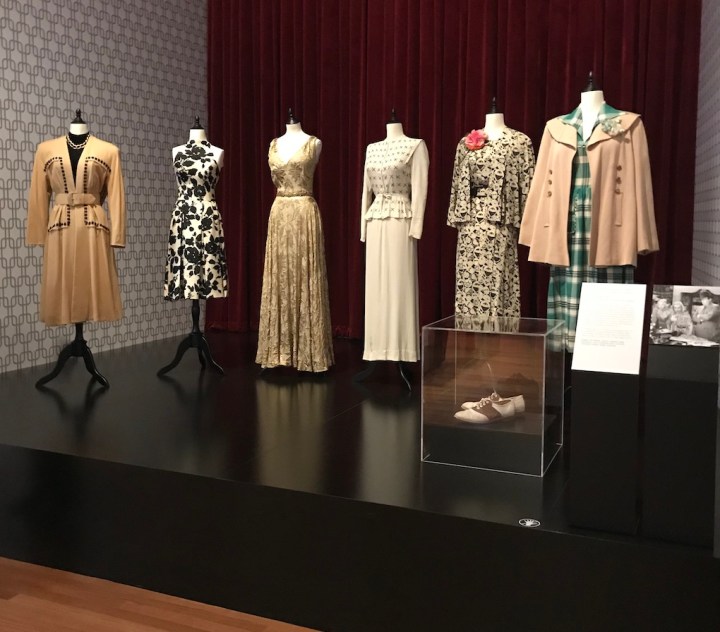
Showcasing costumes created from the 1930s through to the 1960s, many classic, timeless garments, period costume, along with extravagant glamorous gowns, it’s impossible to box Head’s work in, she was a virtuoso in her field. I was bowled over by the garments presented in this exhibition, the installation was impeccable, the garments were accessible, all in all, a very elegantly put together collection.
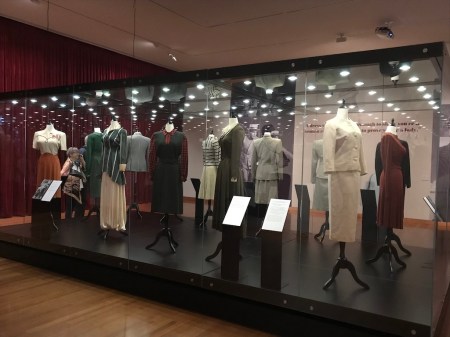
Suits and Tailored costumes
In this post, I share some of my favourite garments, below, a collection that express Head’s skill in working with Pattern and Texture, and are some of my favourite pieces. And I very rarely go in for patterns!
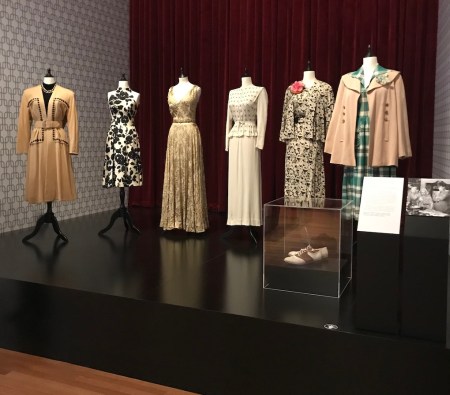
Edith Head Pattern and Texture

Hooded coat worn by Barbara Stanwyck in The Strange Love of Marther Ivers, 1946, and Cocktail dress worn by Martha Hyer in Wives and Lovers, 1963
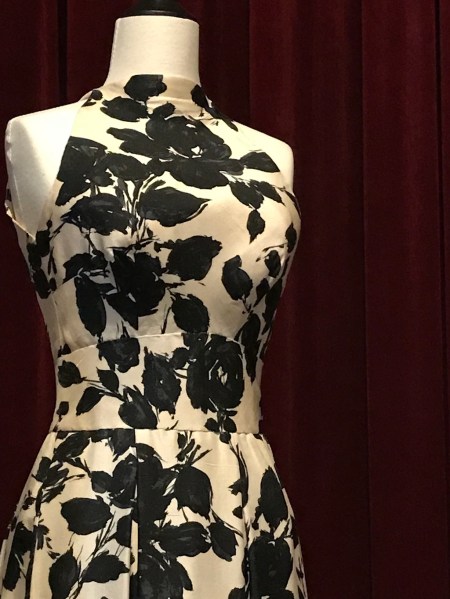
Cocktail dress worn by Martha Hyer in Wives and Lovers, 1963, detail
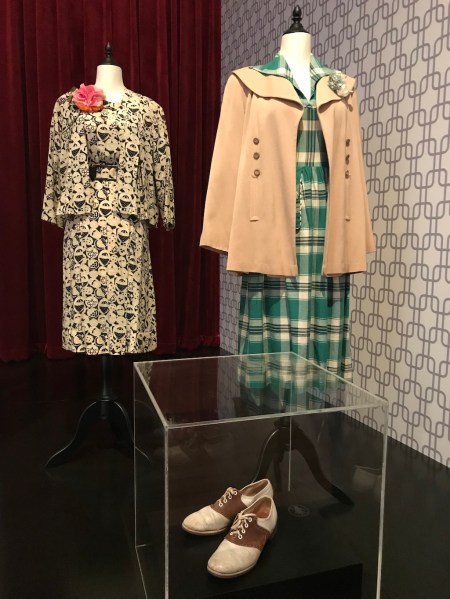
Pattern and Texture two suits and shoes
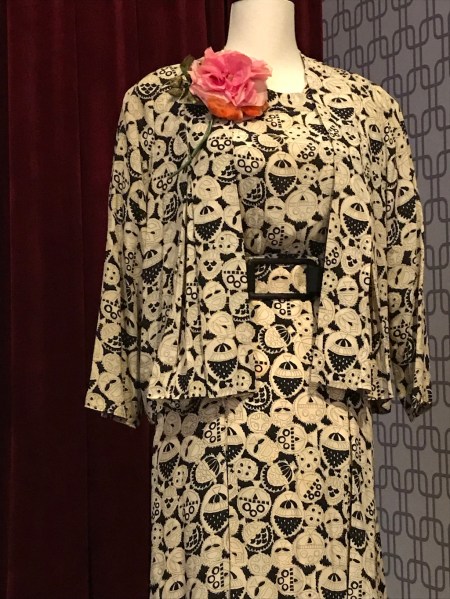
Pattern and Texture suit
So many of the earlier garments bowl you over with that Hollywood glamour that poured out of the film studios in the 40s and 50s, such as the following, which were some of the most stunning in the exhibition.
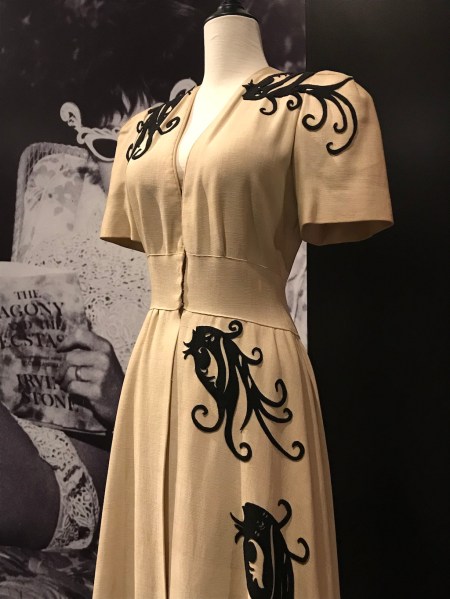
Dressing gown worn by Veronica Lake publicity photo, 1942

Dressing gown worn by Veronica Lake publicity photo, 1942, skirt detail
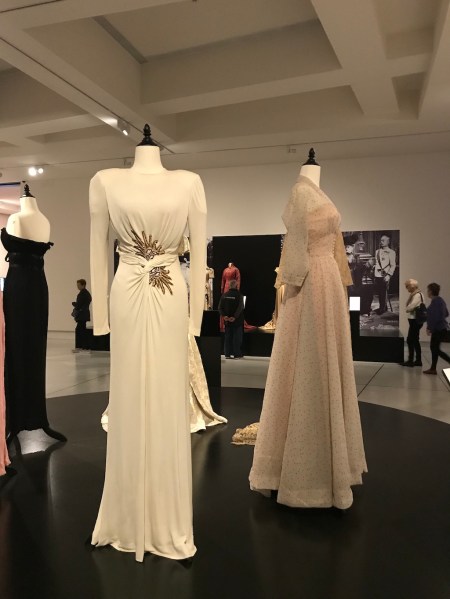
Grecian Style Gown worn by Lizabeth Scott in I Walk Alone, 1947

Grecian Style Gown worn by Lizabeth Scott in I Walk Alone, 1947
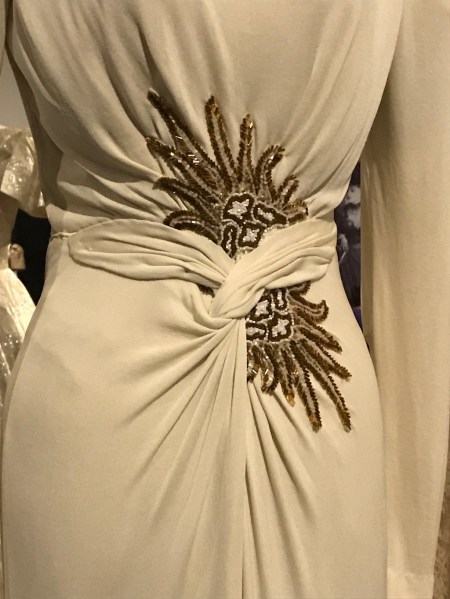
Grecian Style Gown worn by Lizabeth Scott in I Walk Alone 1947, detail

Nightgown with robe worn by June Allyson in Strategic Air Command, 1955
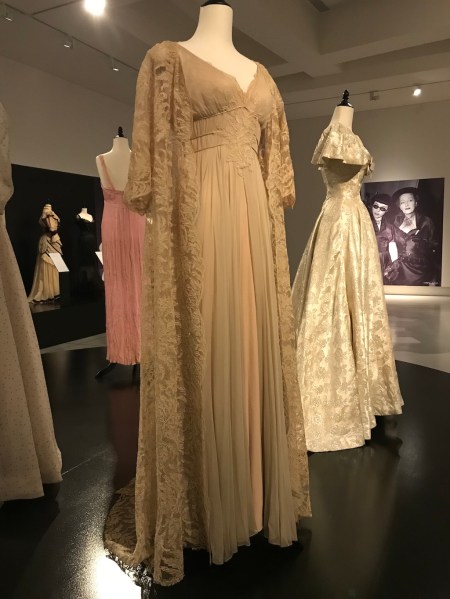
Peignoir set worn by Susan Hayward in Where Love has Gone, 1964
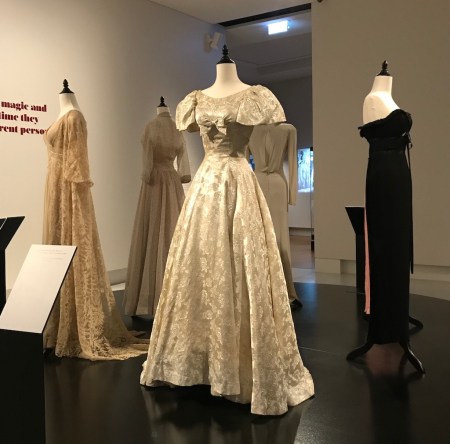
Ball Gown worn by Natalie Wood in Inside Daisy Clover, 1965

Black nightgown worn by Gloria Swanson Sunset Boulevard, 1950

Black Nightgown and Pink Nightgown worn by Gloria Swanson in Sunset Boulevard, 1950
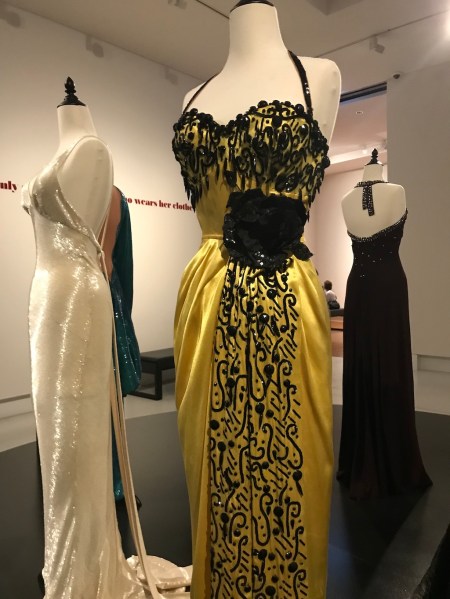
Evening gown worn by Betty Hutton in Somebody Loves Me, 1953

Evening gown worn by Betty Hutton in Somebody Loves Me, 1953
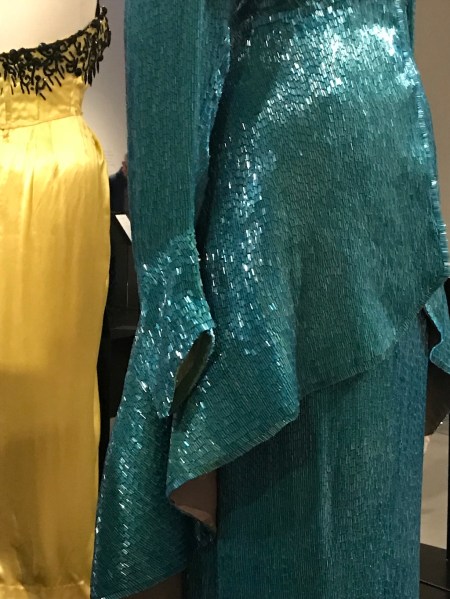
Two piece performance costume worn by Betty Hutton The Perils of Pauline 1947
These costumes represent a specific period in cinema history, musicals, glamour and wildly over the top production was du jour. It’s less fashion more popular fantasy, escapism and storytelling. You can see this amazing beaded number on youtube, The Perils of Pauline, 1947.
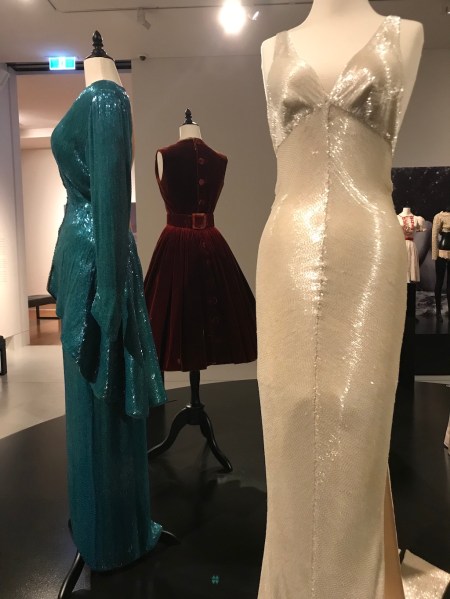
The same two piece from The Perils of Pauline, and my favourite, a cocktail dress worn by Joanne Woodward in A New Kind of Love, 1963
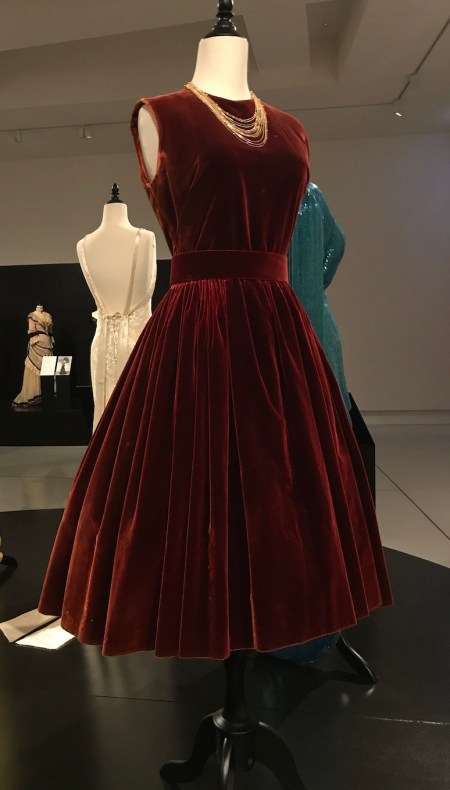
Cocktail dress worn by Joanne Woodward in A New Kind of Love, 1963

Evening gown worn by Joan Fontaine in September Affair, 1955
Many of the garments on display had a star quality of their own, less cast off from another time, they were characters with personality and presence.
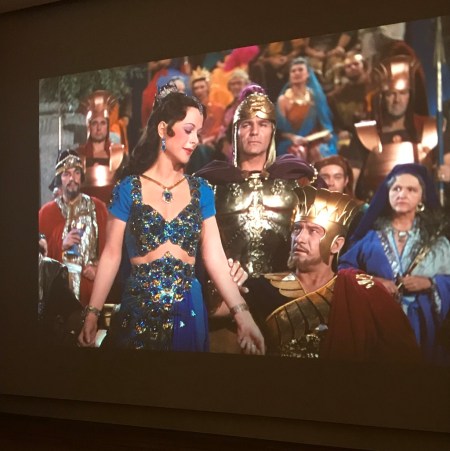
Samson and Delilah, 1949
Having watched some early epic films as a child, it was fabulous to see some costumes in the real, I especially enjoyed this collection, if not for the skill of the workshop that produced them, for the kitchy interpretation of historical Egyptian adornment.
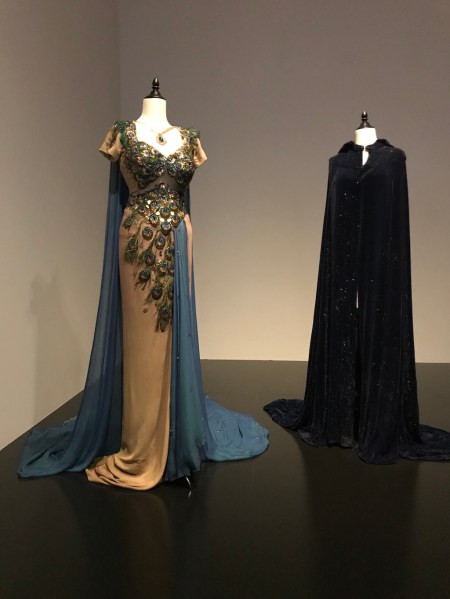
‘Peacock dress’ worn by Hedy Lamarr in Samson and Delilah, 1949 and cloak
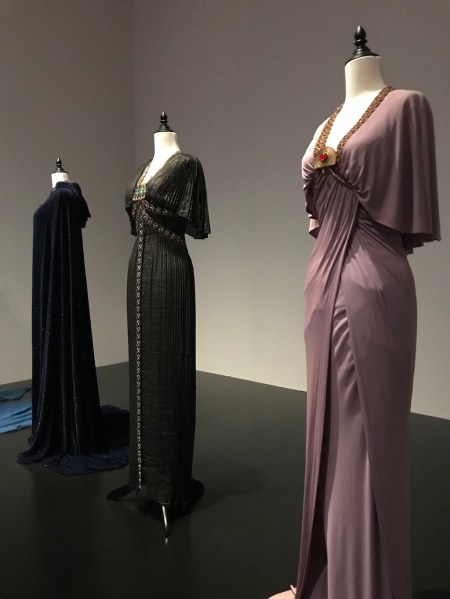
Epic Tales; Egyptian style costumes

Egyptian style costume worn by Nina Foch in The Ten Commandments, 1956
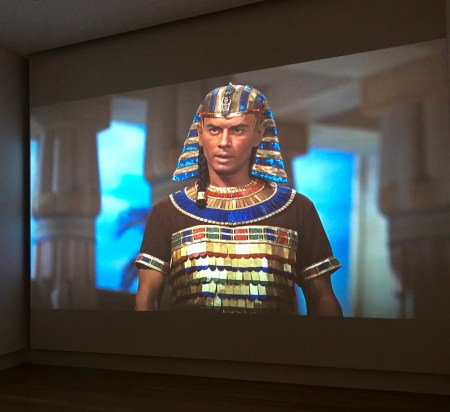
The Ten Commandments, 1956, Yule Brynner
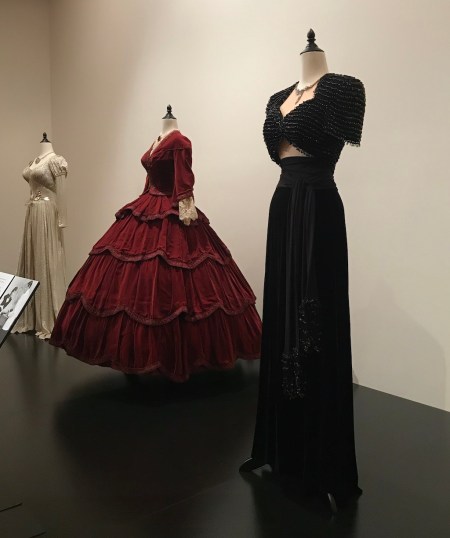
Three Piece worn by Barbara Stanwyck in The Lady Eve, 1941

Three Piece worn by Barbara Stanwyck in The Lady Eve, 1941, detail

Wedding dress worn by Barbara Stanwyck in Sorry Wrong Number, 1948

Wedding dress worn by Barbara Stanwyck in Sorry Wrong Number, 1948
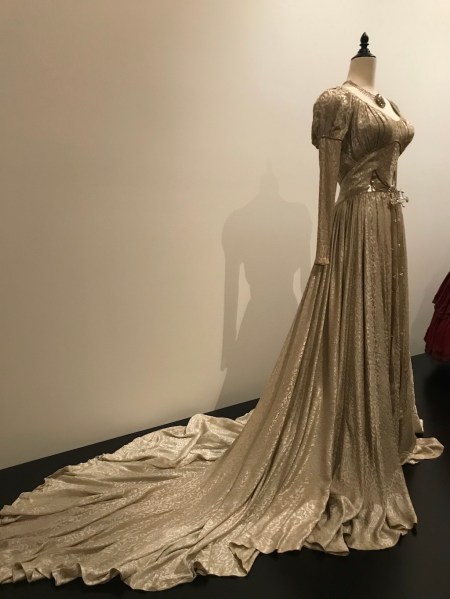
Wedding dress worn by Barbara Stanwyck in Sorry Wrong Number, 1948
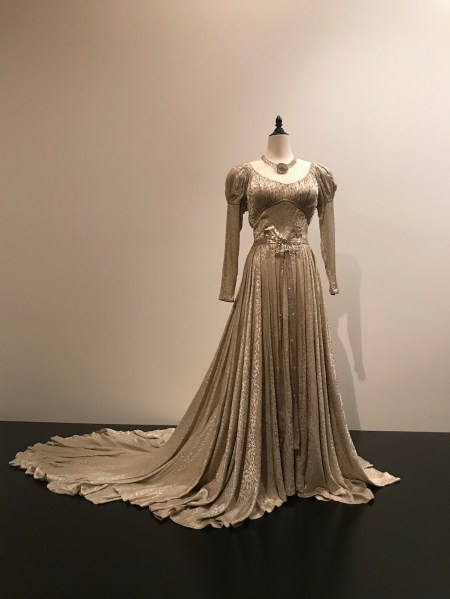
Wedding dress worn by Barbara Stanwyck in Sorry Wrong Number, 1948
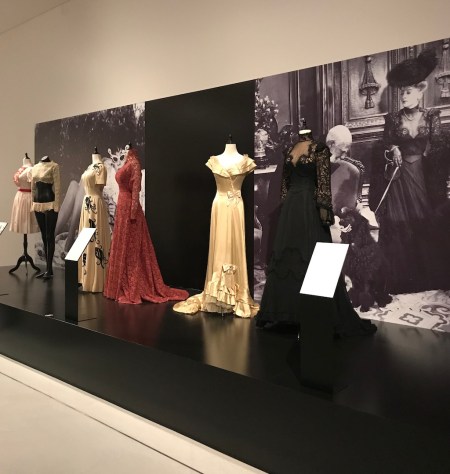
There is so much to see in this exhibition, historical period costume, and some really impressive suits and tailored garments, which just don’t photograph so well behind the glass, including Audrey Hepburn’s cream suit from 1957’s Funny Face. I especially enjoyed seeing design sketches along with the garments, bringing the design process to the fore.
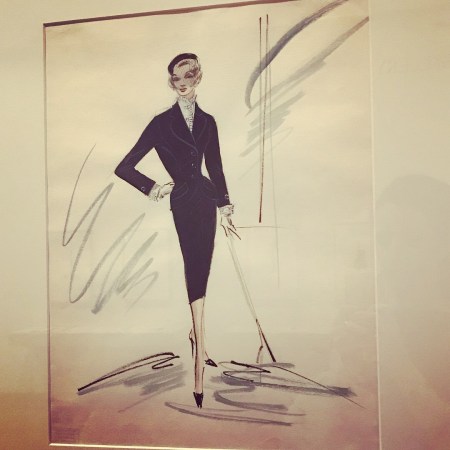
Illustration by Grace Sprague
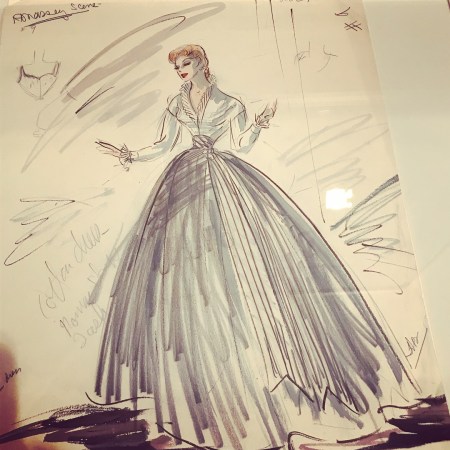
Illustration by Grace Sprague
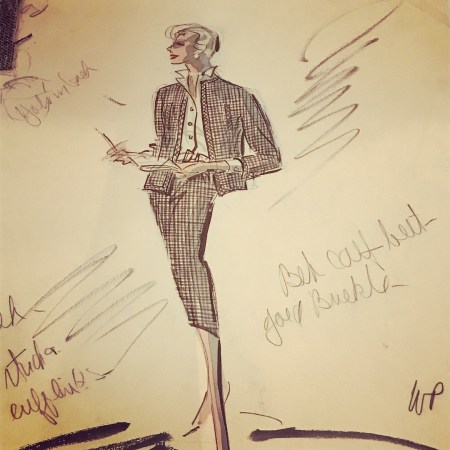
Illustration by Grace Sprague
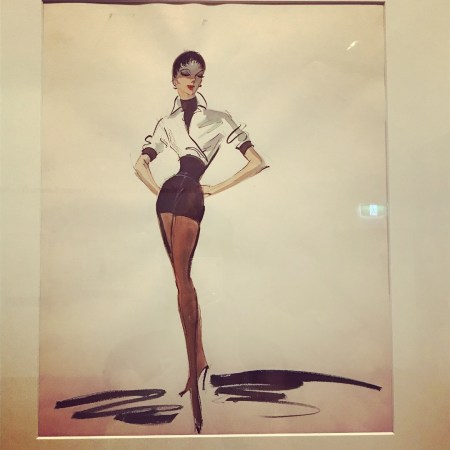
Illustration by Grace Sprague
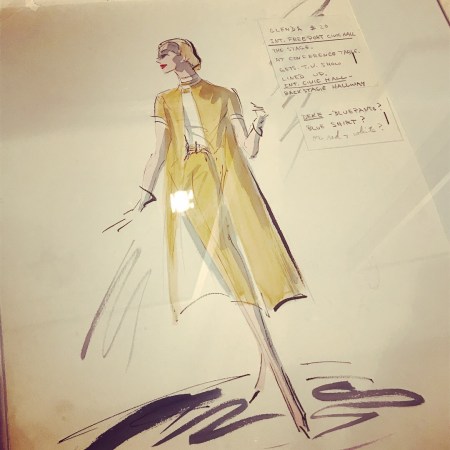
Illustration by Grace Sprague
The Costume Designer features garments worn by Shirley Temple, Gloria Swanson, Veronica Lake, Olivia De Havilland, Jane Russell, Audrey Hepburn, Fred Astaire and Yul Brynner, complementing the costumes on display are film clips and music, and footage of Edith Head at various stages of her career, which are very amusing.
I would love to take my mum to see this exhibition, and I’m planning a summer catching up on some classic cinema.
The Costume Designer: Edith Head and Hollywood
Bendigo Art Gallery, 42 View Street, Bendigo
Exhibition: 29 September 2017 – 21 January 2018Getting there from Melbs was fairly easy, I took a V Line train from Southern Cross Station, and then had just over two hours each way on the train, it was an easy stroll to the Gallery from the terminal. All in all, a worthwhile day trip, I was impressed with how easy public transport is to use and pay for, while feeling a little daunted by the size of Southern Cross Station!
Thanks Bendigo Art Gallery, and Mark Orlandi for helping with travel arrangements and a complementary pass to the exhibition.
This review was first published for The Costume and Textile Association of New Zealand.
artist, writer, curator, mentor

